Methylation data has diverse applications from basic science to
translational research and test development. The modality XPLR analysis
software is a fast and scalable command line interface (CLI) toolkit,
for the analysis of methylation data that is derived from 5-base (duet multiomics solution +modC)
and 6-base (duet multiomics solution evoC) genomes.
The software leverages multi-core, out-of-memory processing to
enable efficient computation on a standard laptop or HPC; allowing users to
work on large datasets with ease.
The modality XPLR analysis software includes tools for exploratory analyses (e.g. computation and plotting of methylation statistics
and differentially methylated regions (DMRs)), as well as supporting downstream analysis
(e.g. feature extraction and export functions). Designed for efficiency and ease of use, it
enables you to rapidly transition from raw data to actionable insights
and publication-ready visualisations.
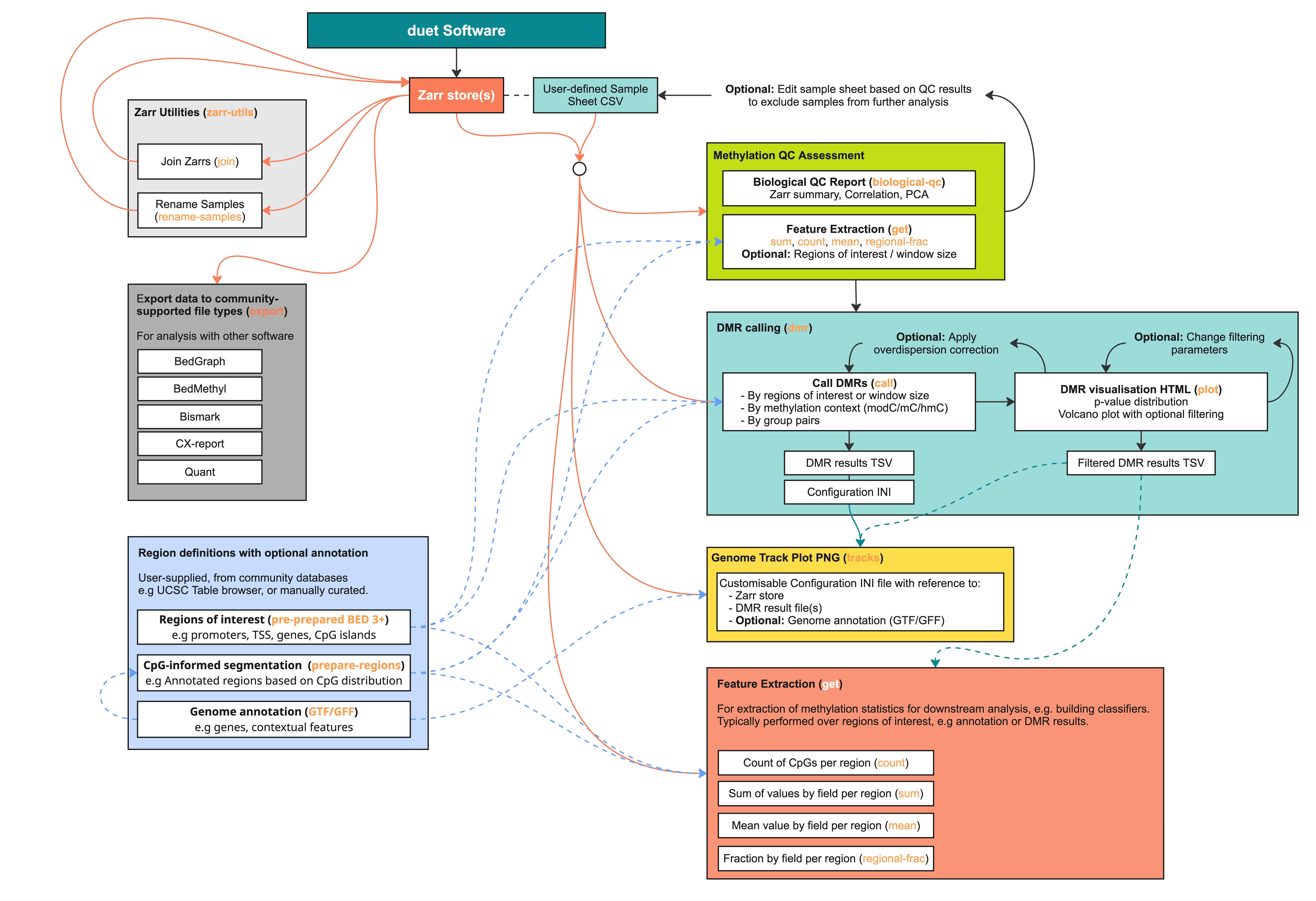
The core data file used by modality XPLR is the Zarr store, which is an array
format that includes methylation and coordinate data, produced by the (duet Software).
The software also allows export to community-supported file types for analysis with other informatics tools.
Figure 1 Schematic of the modality XPLR analysis software and example workflows. The Zarr store is generated by the duet Software, and can be used as input to modality XPLR tools.#
This guide is structured to help you quickly find the information you need. You can navigate through the major sections using the tabs at the top of this page, and then by using the
table of contents on the right side of the page.
Additionally, you can use the search function in the top right-hand corner of the page to find specific topics or keywords across all biomodal software pages.
A summary of recent changes to the software is provided below.
For a full list of changes, please refer to the published release notes PDF by clicking on the version number.