Introduction to modality XPLR#

Methylation data has diverse applications from basic science to translational research and test development. The modality XPLR analysis software is a fast and scalable command line interface (CLI) toolkit, for the analysis of methylation data that is derived from 5-base (duet multiomics solution +modC) and 6-base (duet multiomics solution evoC) genomes. The software leverages multi-core, out-of-memory processing to enable efficient computation on a standard laptop or HPC; allowing users to work on large datasets with ease.

The modality XPLR analysis software includes tools for exploratory analyses (e.g. computation and plotting of methylation statistics and differentially methylated regions (DMRs)), as well as supporting downstream analysis (e.g. feature extraction and export functions). Designed for efficiency and ease of use, it enables you to rapidly transition from raw data to actionable insights and publication-ready visualisations.

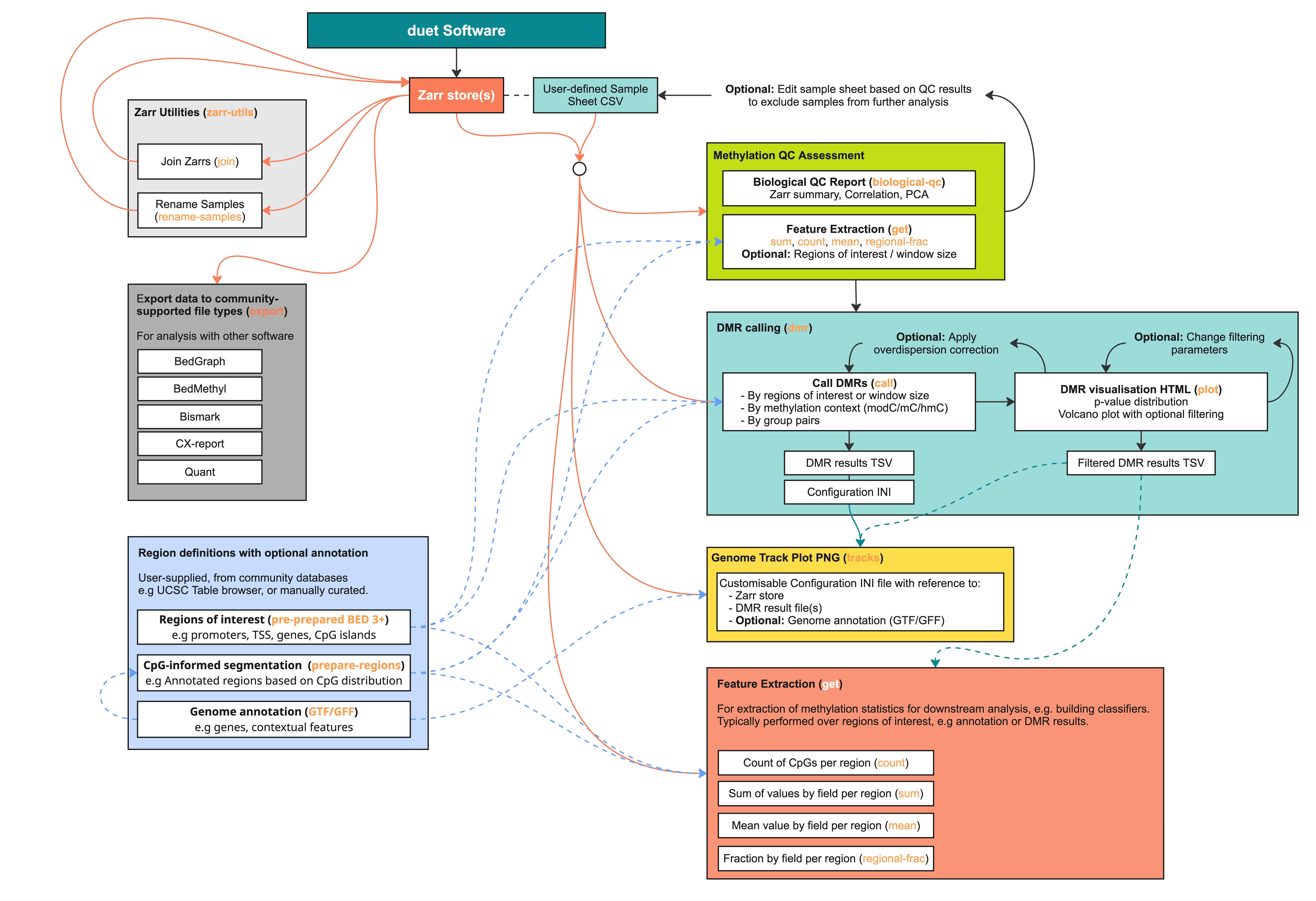
The core data file used by modality XPLR is the Zarr store, which is an array format that includes methylation and coordinate data, produced by the (duet Software).

The software also allows export to community-supported file types for analysis with other informatics tools.

Schematic of the modality XPLR analysis software

Figure 1 Schematic of the modality XPLR analysis software and example workflows. The Zarr store is generated by the duet Software, and can be used as input to modality XPLR tools.#

User documentation contents#

How to use this guide#

Release notes#

A summary of recent changes to the software is provided below. For a full list of changes, please refer to the published release notes PDF by clicking on the version number.

Release version

Date

Description of changes

v1.0.0

2025-Nov-17

  • Official stable release following beta testing.

  • Added authentication.

  • Added HTML report for get commands.

  • Added optional regional heatmap visualisation for get regional-frac commands.

  • Added prepare-regions entrypoint for CpG-informed region segmentation and annotation.

  • Added --num-contexts filter in dmr call and get commands.

  • Added controls for merging CpG strands in biological-qc, get and export commands.

  • Unified behaviour to merge CpG strands by default in all entrypoints, disable with -dsm.

  • Unified behaviour of --aggregate-by-group across entrypoints.

  • Added --order-by-group option to improve visualisations by sample metadata.

  • Improved labelling of annotation types in the DMR Report HTML.

  • Improved support for handling Zarr store merging.

  • Updated Core Workflow to v1.3 with improved usability and performance.

  • Handle DMR calling with insufficient samples for statistical tests.

  • Bug fixes and improvements.

v1.0.0b4 (beta)

2025-Oct-03

  • Resolved issue with v1.0.0b3 installations in new environments due to versioning of CLI dependency.

  • Bug fixes and improvements.

v1.0.0b3 (beta)

2025-Sep-22

  • Ensure consistency of operation names and output file prefixes across entrypoints.

  • Standardisation of --min-coverage method to use mean context coverage across all samples.

  • Performance improvements to biological-qc Pearson correlation and PCA.

  • tracks smoothing method updated to use coverage-weighted Gaussian kernel-based approach.

  • Core Workflow updated to v1.2 with usability improvements and overdispersion toggle.

  • Improved documentation, --help text and FAQs.

  • Bug fixes and improvements.

v1.0.0b2 (beta)

2025-Aug-04

  • Biological QC --group-name option updated to --aggregate-by-group.

  • Include more metadata information in the Biological QC Sample Information table.

  • Added metadata-based colour formatting for PCA plots on the Biological QC HTML report.

  • Added DMR statistics table to the HTML report (dmr plot function).

  • Fixed issue with methylation trace and mod-difference smoothing on Tracks plot.

  • Fixed issue with --merge-cpg-strands in dmr call and tracks.

  • Updated support for Core Workflow.

  • Fixed contig name issue with pre-prepared bed files for mouse references and added mm10p6.

v1.0.0b1 (beta)

2025-Jun-30

Initial beta release.